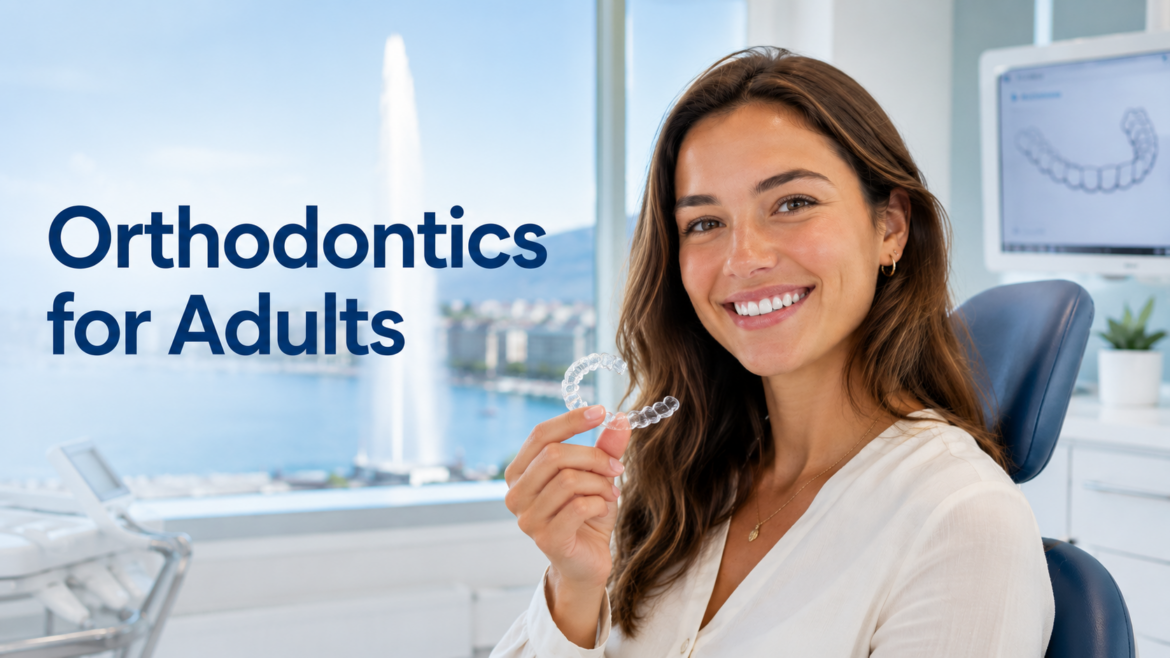
Orthodontics for Adults in Geneva
Adults come to me for three reasons. Their teeth have shifted after a treatment done in adolescence. They never had the opportunity to be treated as children. Or a functional problem has worsened over the years: wear, jaw joint discomfort, difficulty chewing evenly.
There is no upper age limit for orthodontic treatment. There are conditions, and they differ from those that apply to a teenager.
Is it too late?
No, provided the bone and gums are healthy.
Teeth move throughout life, in both directions. That is why yours have shifted, and it is also why they can be straightened at fifty as well as at fifteen.
The difference is growth. In an adolescent, the development of the jaws can be guided. In an adult it cannot, so the result has to be achieved through tooth movement alone, sometimes with auxiliary devices. The planning is more demanding, and the choice of practitioner matters more.
The real condition is not age but the state of the periodontium. Inflamed gums or reduced bone support must be treated first. I do not begin treatment on an unstable periodontium, and if that is your situation I will refer you to a periodontist before anything else. Moving teeth through diseased bone makes the problem worse rather than better.
Straightening teeth is not enough
This is where I differ from part of the profession.
Many adult treatments address only the visible front teeth. The result looks satisfactory in a photograph and deteriorates within months, because nothing has changed in the way the jaws meet. The forces of chewing continue to act as before, and they return the teeth to where they were.
I treat the bite in adults, including where growth has finished. For Class II and Class III cases I frequently use the Carriere Motion distaliser as a first stage, which makes situations treatable with aligners that are widely assumed to require fixed appliances or surgery.
This requires more planning and sometimes costs slightly more. It holds.
The discreet options
Visibility is the first question almost every adult patient asks. They work, they speak in public, and they do not want to spend two years in metal braces.
Invisalign accounts for roughly 90 percent of my adult treatments. The clear aligners are removed for meals and for important meetings. It is the option that fits a working life most easily.
SPEED brackets remain indicated where a fixed appliance gives better control. They are more discreet than conventional brackets and work without visible elastics.
I will tell you at the first appointment which option suits your case. Not every situation can be treated with aligners, and I would rather say so than sell you the most requested option.
Crowns, implants and missing teeth
These are common in adults and do not prevent treatment.
A crown moves like a natural tooth. An implant does not: it is fixed in the bone and becomes an anchorage point around which other teeth move, which has to be built into the plan from the start.
Where teeth are missing, orthodontics often prepares the ground. Space is reopened for a future implant, or closed to avoid a prosthesis altogether. These treatments are carried out together with your dentist or periodontist, and I coordinate the sequence with them.
How long it takes
A complete adult treatment usually runs from twelve to twenty-four months, depending on complexity. Limited alignment can finish in six to nine months.
At the end I bond a fixed retainer to both arches. It is a discreet wire behind the teeth, invisible from the outside. In adults more than in adolescents, this is what separates a result that lasts from one that unravels within three years. Many of my adult patients come to me precisely because their teenage treatment was never stabilised.
What it costs
Most complete treatments fall between CHF 8,500 and CHF 10,200, all inclusive. More limited treatments start at CHF 5,000.
The first consultation, including the first digital iTero scan, is not charged. If we decide together to proceed, the full diagnostic workup, meaning radiographs and a detailed treatment plan, is charged between CHF 600 and CHF 1,400. That amount is deducted from the treatment price if you go ahead.
A note for international patients
Geneva’s international community makes up a large share of my adult patients. Two points are worth knowing.
Swiss basic insurance (LAMal) does not reimburse adult orthodontics. Supplementary dental policies may cover part of it, subject to a waiting period, which means a policy taken out today will not cover a treatment started next month.
International dental policies cover adult orthodontics more often than Swiss supplementary cover, and sometimes on better terms. If you hold international cover, send us your conditions and we will tell you what is likely to be reimbursed.
Consultations are held in English, French and German.
The first appointment
I examine your situation, you tell me what bothers you, and we take a first digital iTero scan. You leave with my opinion on what is possible in your case and what is not. This first visit and this first scan are not charged.
Orthodontie MC20 Rue Micheli-du-Crest 20, 1205 Geneva Telephone: +41 22 781 47 60
Consultations also in Satigny and Nyon.