Invisalign in Geneva — Diamond Apex Provider
INVISALIGN® treatment
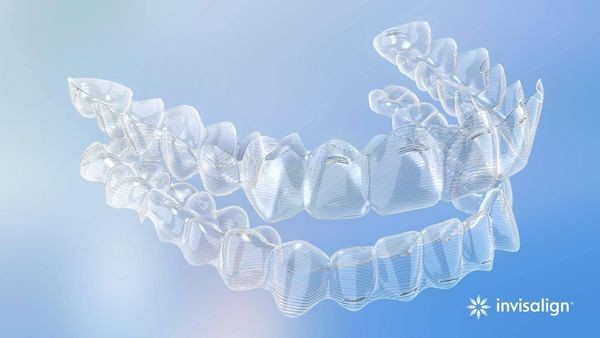
Invisalign is treatment with clear aligners: a series of removable trays, changed every two weeks, that move the teeth gradually to the planned position.
I have carried out this treatment since the system arrived in French-speaking Switzerland. Align Technology has awarded me Diamond Apex Provider status, held by the top 1 percent of practitioners in the EMEA region, after more than 3,000 cases treated. That does not make the treatment better in itself. It means I have seen a great many cases resemble yours, and I know early on what is going to cause difficulty.
How aligner treatment works
Each aligner is manufactured specifically for your teeth. You wear it twenty-two hours a day and remove it to eat and to brush. Every two weeks you move to the next one.
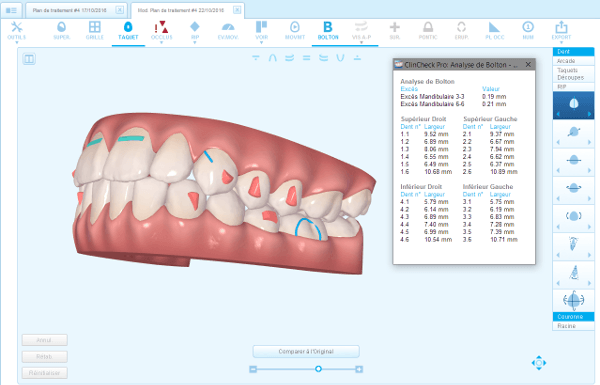
Before anything is manufactured, I build a three-dimensional treatment plan in ClinCheck. You see the starting position, each intermediate stage and the intended result. You approve that plan before the first aligner is produced, so you know what you are committing to before treatment begins.
Aligning teeth or treating the bite
This distinction explains most of the differences in price and in outcome between practices.
Alignment corrects the visible position of the front teeth. Complete treatment also corrects the occlusion, meaning the way your upper and lower teeth meet.
I treat the occlusion, including in adults whose growth has finished. Straightening teeth without correcting how they meet gives a satisfactory result for a few months, after which the forces of chewing return the teeth towards where they started.
For Class II and Class III cases I frequently use the Carriere Motion distaliser as a first stage, before the aligners. That combination makes situations treatable with aligners that are widely assumed to require fixed appliances, or even surgery. It is what separates a practitioner who uses Invisalign from one who has mastered it.
Who it suits
Adults. Around 90 percent of my adult treatments are carried out with aligners. They come out for a business lunch or a presentation, which explains why patients who refused fixed braces accept them.
Teenagers. The aligners carry compliance indicators that change colour. Checking wear becomes a matter of fact rather than an argument, which parents generally welcome.
Children. Depending on the case and the age, aligner treatment is possible, sometimes after a first phase with a different appliance. I propose an early phase only where it is indicated.
Not every case can be treated with aligners. Where fixed braces give better control, I propose them and explain why.
What is included
The iTero scan with no physical impression, ClinCheck planning with a simulation of the result, all the aligners required, refinements, fixed retention on both arches, and review appointments throughout treatment.
Retention deserves separate mention. A discreet wire bonded behind the teeth holds the result without depending on your daily discipline. A significant share of my adult patients come to me because their teenage treatment was never stabilised. It is included in the price. It is not an option.
How long it takes
Simple alignment takes six to nine months. Moderate complete treatment, twelve to eighteen months. A complex case, eighteen to twenty-four months. These durations assume the aligners are worn consistently.
What it costs
Most complete treatments fall between CHF 8,500 and CHF 10,200, all inclusive. More limited treatments start at CHF 5,000.
We publish the detail: the three formulas, what each includes, two-phase treatment in children, and what Swiss insurance covers.
The first appointment
I examine your situation and we take a first iTero scan. You leave with my opinion on what is possible in your case and what is not. This first visit and this first scan are not charged.
Consultations are held in English, French and German.
Orthodontie MC20
Rue Micheli-du-Crest 20, 1205 Geneva Telephone: +41 22 781 47 60
Consultations also in Satigny and Nyon.